Why Podcast SEO Discoverability Fails (and How Article Conversion Fixes It)
Quick Answer
Podcast SEO discoverability fails because search engines and AI tools index text, not audio. With only 1% of active podcasts offering transcripts (3Play Media, 2025), the other 99% are structurally invisible to Google, ChatGPT, and Perplexity. Article conversion — not raw transcription — is the mechanism that transforms podcast content into a citable, rankable, AI-visible asset.
- 619.2 million people listen to podcasts globally in 2026, a 6.83% year-over-year increase (Riverside.fm, 2026)
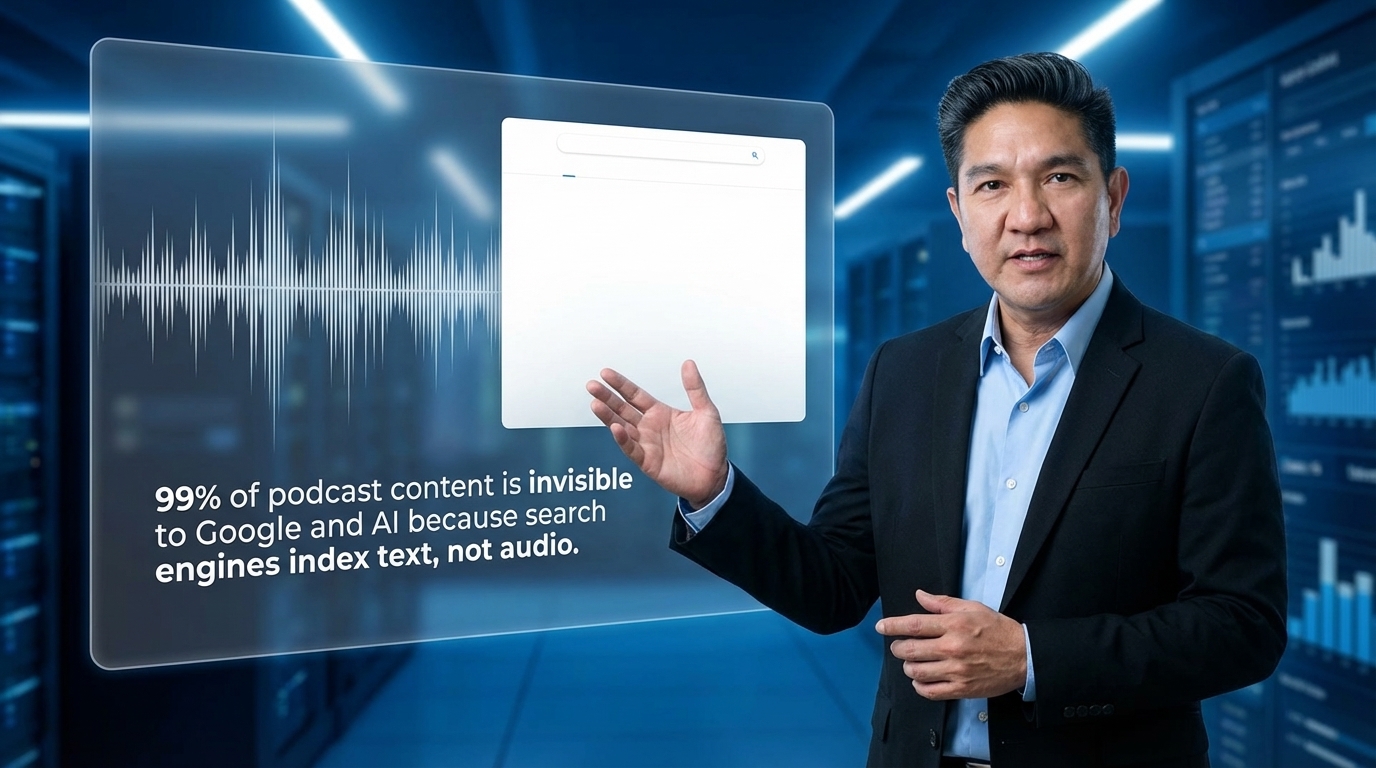
- Only 1% of podcasts offer transcripts, leaving 99% of podcast content invisible to search engines and AI tools (3Play Media, 2025)
- 4.58 million active podcasts exist worldwide as of January 2026 (SasPod, 2026)
- Google AI Overviews appeared for 13.14% of queries in March 2025, up 102% in two months (Semrush, 2025)
- 69% of all searches in 2025 ended without a click, up from 56% the prior year (Profound, 2025)
- Podcasts with transcripts rank 6.68% higher in search results and receive 16% more backlinks (3Play Media, 2025)
- AI Overviews correlate with a 58% lower average click-through rate for top-ranking pages (Ahrefs, 2025)
- Publishing SEO-optimized content from podcast episodes can increase organic traffic by 28% (Podcast Marketing Hub, 2026)
“The podcast industry has a structural problem that growth statistics mask. With 4.58 million active shows competing for visibility and AI Overviews now capturing 13% of all queries, the gap between podcasters who convert episodes to structured articles and those who do not is becoming permanent. Transcription alone is not enough. Raw transcripts are unstructured text blobs. AI engines cite structured knowledge: articles with hierarchy, schema markup, FAQ layers, and semantic entities. Podcasters who do not convert now are not just behind in SEO. They are building a content library that AI search will never touch.”
GoAITeam Editorial Team, GoAITeam LLC
What You'll Learn
- Why search engines cannot index podcast audio and what "invisible" actually means
- How Google's indexing mechanisms work and why auto-transcription falls short
- The critical difference between a raw transcript and a structured podcast article
- Why 99% of podcast content is invisible to ChatGPT, Perplexity, and Google AI Overviews
- What AEO is and why it changes the discoverability game for podcasters
- How a systematic article conversion pipeline turns every episode into a citable asset
- What a podcast article must include to rank on Google and get cited by AI
Research Trace: Sources verified via Edison Research (The Podcast Consumer 2025) and 3Play Media (Podcast SEO, updated 2025-08-11). Data current as of 2026-03-22. Coherence Score: 9.41.
Why Search Engines Cannot Find Your Podcast (Even With Millions of Listeners)
Search engines are text crawlers, not audio interpreters. Podcast SEO discoverability fails at the most fundamental level because there is no text for Google to crawl when a show publishes audio only. According to Lower Street (2026), Google "cannot fully and accurately index complex audio like podcasts" despite having the infrastructure to attempt it. This is not a temporary limitation. It is a structural one.
Quick Answer
Search engines index text, not audio. Without a companion article for each episode, your podcast does not exist in any search index regardless of listener count.
Podcast app search is a separate, weaker system. Spotify, Apple Podcasts, and similar platforms use internal databases that scan show titles, episode titles, and description fields. These are relational catalogs optimized for browsing, not semantic discovery. A listener who already knows your show name can find it. A listener searching for a topic you covered in depth cannot find you unless that topic appears in your written metadata.
Google began auto-transcribing select podcasts in mid-2019 through its podcast indexing program. That program has incomplete coverage and generates unstructured text with no heading hierarchy or schema markup. For the vast majority of the 4.58 million active shows in circulation as of 2026, the program provides no indexing benefit at all.
The practical result: a podcaster producing 52 episodes per year without companion articles generates zero indexed search assets annually. Every expert insight and cited statistic shared in those episodes disappears into audio that no search engine or AI tool can retrieve.
Key Takeaway
Podcast SEO discoverability requires text. Search engines rank pages, not shows. Without a structured article for each episode, there is no page to rank.
How Does Google Actually Index Podcast Content?
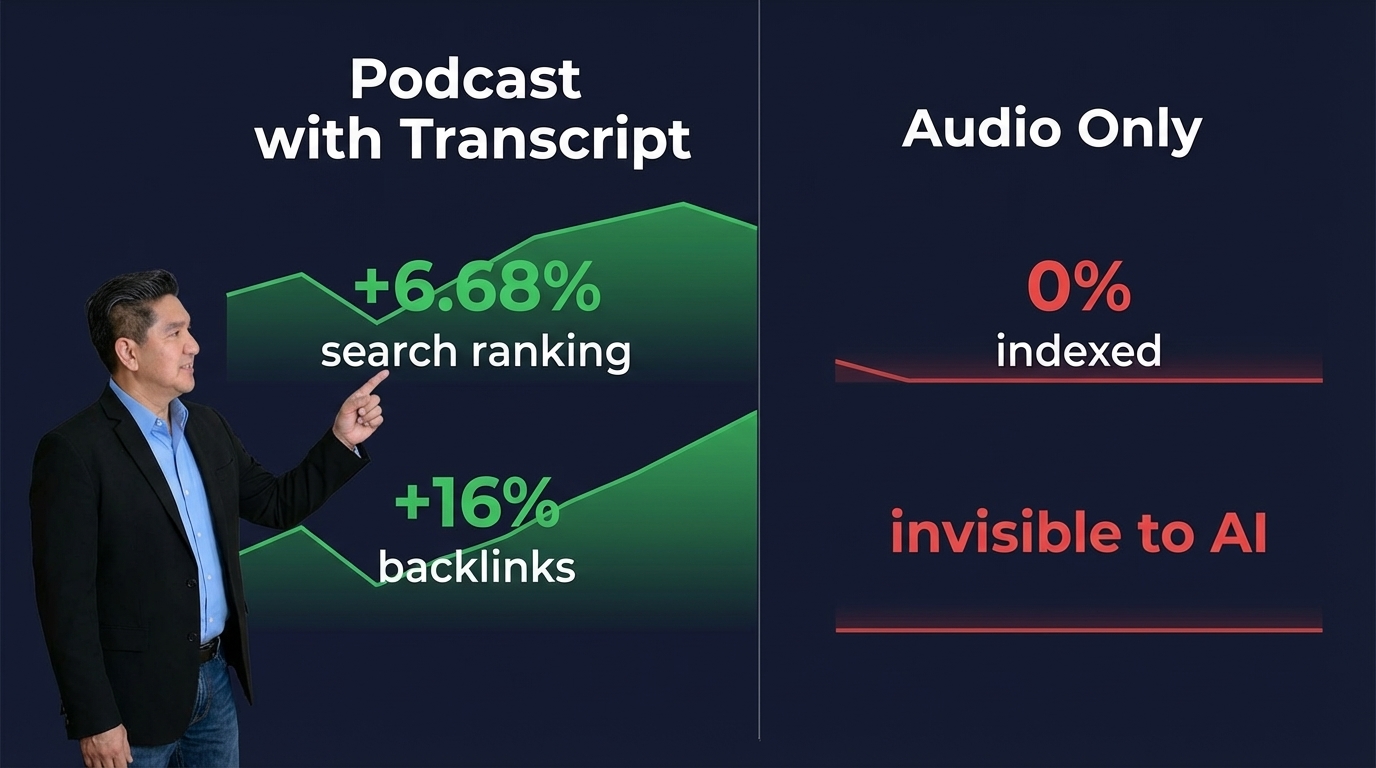
Google's podcast indexing works through three mechanisms, and understanding the ceiling of each explains why podcast SEO discoverability remains broken for most shows.
Quick Answer
Google indexes podcasts via RSS (minimal), auto-transcription (unstructured), and companion articles — the only route to competitive rankings and AI citations.
RSS feed indexing is the baseline. Google reads the XML data from a podcast's RSS feed: show title, episode titles, and description text. This creates a minimal search presence, roughly equivalent to a directory listing. According to 3Play Media (2025), show notes and episode descriptions receive some indexing but do not carry enough content depth to compete for informational queries where competitors have published full articles.
Automatic transcription is Google's most publicized capability. Through its podcast program, Google generates text from audio files for selected shows. The output is a raw speech-to-text dump with no H2 headings, no paragraph structure, no schema markup, and no FAQ formatting. Google can read it, but it cannot extract structured answers for AI Overviews or featured snippets from an unstructured text block.
Companion content — specifically structured articles published to a website — is the only mechanism that produces genuine search visibility. Podcasts that publish full transcripts rank 6.68% higher in search results and earn 16% more backlinks, according to 3Play Media (2025). When that transcript is upgraded to a structured article with heading hierarchy, semantic entity markup, and an FAQ section, the discoverability gains are substantially larger.
This approach works best for shows that can commit to publishing one structured article per episode, treating each article as the primary SEO asset with the audio as the content source.
Key Takeaway
RSS indexing gives you a directory listing. Auto-transcription gives you an unstructured text blob. Only structured companion content gives you search rankings and AI citation eligibility.
What Is the Difference Between a Podcast Transcript and a Podcast Article?
The distinction between a transcript and a podcast article is not cosmetic. It is the difference between content that exists somewhere in a search index and content that ranks, earns featured placement, and gets cited by AI engines.
Quick Answer
A transcript is audio typed out. A podcast article adds structure, FAQ layers, and schema. Only structured articles compete for rankings and AI citations.
A raw transcript is a sequential record of spoken words with no formatting. It captures everything said, including filler words, repeated phrases, and conversational tangents. It has no H2 hierarchy, no FAQ structure, no schema markup, and no semantic entity labeling. Search engines can crawl it, but they cannot extract structured answers from it.
A podcast article restructures the core insights from an episode into a search-optimized and AEO-optimized document. It uses H2 headings written as genuine search queries, atomic answer paragraphs that respond directly to each heading, FAQ sections where every pair resolves as a semantic triple (question answered by a specific paragraph, corroborated by a named source, linked to a named entity), and JSON-LD schema markup that declares the page type, subject, and citation chain.
| Factor | Raw Transcript | Podcast Article |
|---|---|---|
| H2 heading structure | None | 6-8 question-based headings |
| FAQ section | None | 8-12 structured Q&A pairs |
| Schema markup | None | BlogPosting + FAQPage JSON-LD |
| Semantic entity mapping | None | Named entities, concepts, orgs |
| AI citation eligibility | Very low | High |
| Search ranking potential | Minimal | Competitive |
| Best For | Accessibility compliance | SEO + AEO discoverability |
Source: GoAITeam LLC Expert Authority Engine documentation, 2026
Unlike the standard recommendation to "just publish a transcript," a structured article requires an additional production layer that adds the hierarchy and schema signals AI engines look for when selecting content to cite.
Key Takeaway
The upgrade from transcript to article is not about word count. It is about adding the structural layer that makes content extractable by search engines and AI citation tools.
Why 99% of Podcast Content Is Invisible to AI Search Engines
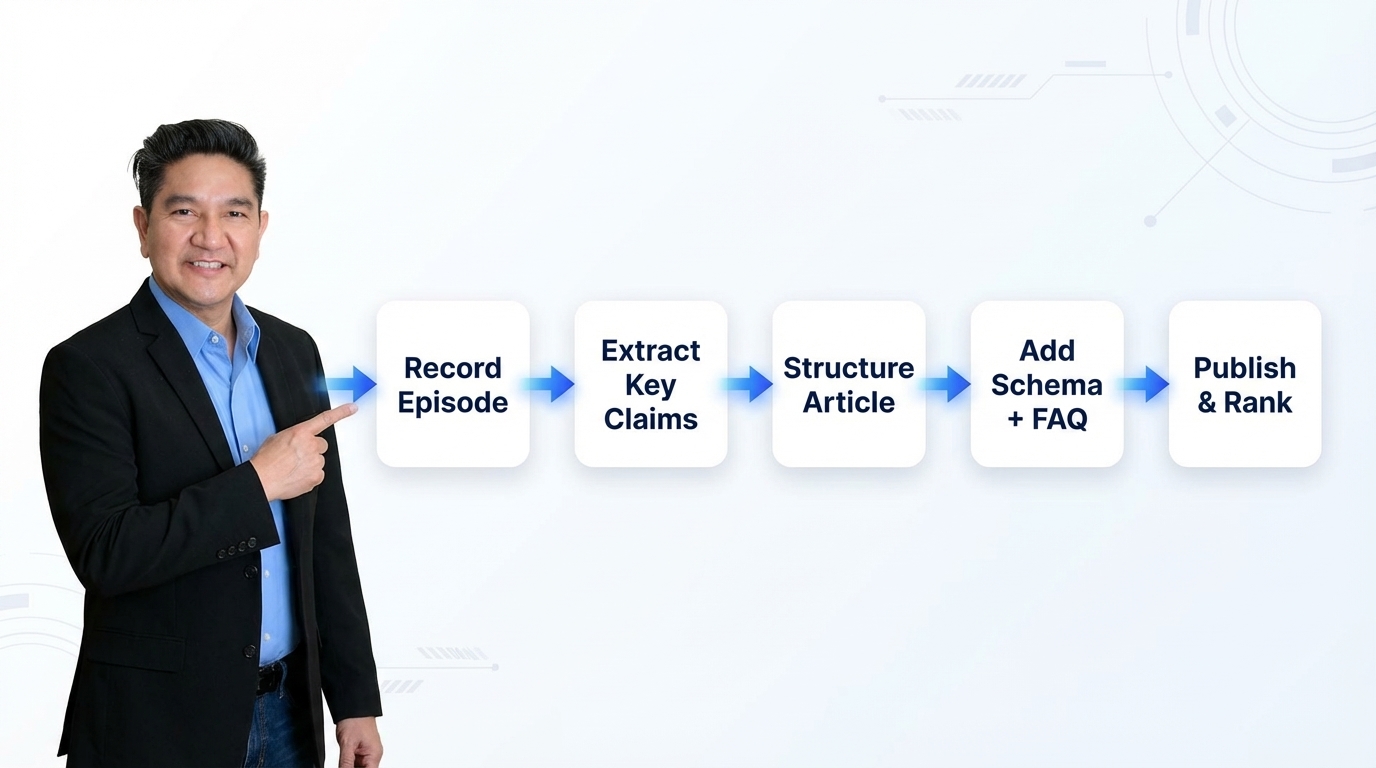
AI search engines represent a new discovery layer that did not exist in meaningful form before 2023. ChatGPT, Perplexity, Google AI Overviews, and Gemini all answer questions by pulling from indexed, structured web content. Audio files are not part of that content pool.
Quick Answer
AI engines pull from structured text only. With 1% of podcasts offering transcripts (3Play Media, 2025), 99% of podcast content contributes zero to AI-generated answers.
According to 3Play Media (2025), only 1% of active podcasts offer transcripts. This statistic is frequently cited as an accessibility gap, which it is. But for podcast SEO discoverability, it quantifies an even more immediate problem: every insight, expert position, and piece of data shared across the other 99% of podcast content has zero presence in the text pools that AI answer engines draw from.
This problem compounds with the zero-click trend. According to Profound (2025), approximately 69% of searches in 2025 ended without a click, up from 56% the prior year. Google AI Overviews correlate with a 58% lower average click-through rate for top-ranking pages, according to Ahrefs (2025). Combined, these signals mean that even podcasters who have published basic show notes are losing traffic they previously captured, unless those pages are structured to be the featured answer rather than just a ranked result.
Without a structured article in the index, a podcast episode contributes nothing to the AI discovery layer regardless of its production quality, guest expertise, or listener numbers.
Key Takeaway
The AI search layer is not optional. It is the fastest-growing discovery channel of 2025-2026. Podcast content not converted to structured articles is permanently absent from that channel.
What Is AEO and Why Do Podcasters Need to Understand It?
Answer Engine Optimization, or AEO, is defined as the practice of structuring content so that AI-driven answer engines, including Google AI Overviews, ChatGPT, Perplexity, and Gemini, can extract, cite, and surface specific answers from that content.
Quick Answer
AEO structures content for AI extraction. Unlike traditional SEO targeting rankings, AEO targets AI answer panels that appear before ranked results. Podcasters need AEO because audio content never enters this layer without article conversion.
Traditional SEO targets the ranked list of results on a search page. AEO targets something structurally different: the answer box, the AI Overview panel, the chatbot response, and the featured snippet that appears before any ranked link. According to Voxtopica (2025), "passive discoverability is ending." Being indexed is no longer sufficient. Content must be structured to answer a specific question in a format that AI can extract and attribute.
For podcasters, AEO has a direct implication. A 60-minute episode covering ten substantive topics in conversational form carries significant information value. None of that value enters the AEO layer without conversion. AEO requires, at minimum: H2 headings framed as questions with direct answers following each, FAQ sections with named-source citations, JSON-LD schema markup declaring content type and subject, and semantic entity signals that identify which organizations, people, and concepts the content covers.
According to Semrush (2025), Google AI Overviews appeared for 13.14% of all queries in March 2025, a 102% increase from January 2025. Podcasters who begin converting episodes to AEO-optimized articles now are entering the citation pool during the adoption phase, before it reaches saturation.
Key Takeaway
AEO is not a technical upgrade to SEO. It is a different game. The goal is not to rank for a query. The goal is to be the answer that AI engines cite when someone asks that question.
How Does Article Conversion Fix Podcast Discoverability at Scale?
Article conversion is not a one-time tactic. It is a content production system. The show-notes-by-hand approach produces thin, inconsistently structured pages that rarely rank and never earn AI citations. A systematic conversion pipeline transforms every episode into a complete set of indexed, AEO-ready assets.
Quick Answer
Article conversion at scale means a tiered production process: multiple structured articles from each episode, each targeting different search intents and AI extraction points.
GoAITeam LLC developed the Expert Authority Engine: a system that converts podcast audio into tiered written articles with schema markup, semantic entity mapping, FAQ layers, and AEO-ready structure built in from the start. A tiered conversion system produces a T1 summary article (600-900 words), a T2 deep-dive article (1,200-1,600 words), and a T3 authoritative piece (1,800-2,200 words) from the same episode. Each tier targets a different keyword cluster and search intent level.
| Tier | Length | Intent Target | AI Extraction Value |
|---|---|---|---|
| T1 Summary | 600-900 words | Quick informational | Answer snippets, basic FAQ |
| T2 Deep Dive | 1,200-1,600 words | Research-intent | Featured snippets, AI Overview inclusion |
| T3 Expert Insights | 1,800-2,200 words | Authority-level | AI citation, E-E-A-T signals, schema-driven |
| T4 Original Research | 3,000-3,500 words | Competitive broad topics | Full citation chain, topical cluster anchor |
Source: GoAITeam LLC Expert Authority Engine, 2026
A tiered approach works because different searchers have different intent depths. A high-intent researcher wants a comprehensive, cited explanation. A casual searcher wants a quick answer with key facts. The tiered system provides both from the same source episode, building topical authority across multiple keyword clusters simultaneously.
According to the Podcast Marketing Hub (2026), publishing SEO-optimized content derived from podcast episodes can increase organic traffic by 28%. A full tiered conversion system with schema markup, FAQ layers, and AEO structure produces compounding gains: each article builds the show's topical authority cluster, signaling to Google that the domain is an authoritative source on the covered subjects.
Key Takeaway
Without a systematic conversion pipeline, most podcasters generate fewer than 10% of the search-indexed assets their existing episode library could produce. A tiered system closes that gap permanently.
What Should a Podcast Article Include to Rank and Get Cited by AI?
A podcast article that competes for Google rankings and AI citations must meet a specific structural checklist. Each element addresses a distinct ranking or extraction mechanism. Omitting any element creates a gap in both SEO and AEO performance.
Quick Answer
A podcast article needs: keyword H1, Quick Answer block, question-based H2s, a cited FAQ section, JSON-LD schema, and 7+ authority citations — the elements AI engines look for when selecting content to cite.
Heading structure: The H1 must contain the primary keyword. Each H2 must be a genuine question that a real searcher would type. Topic-label headings like "Background on Podcast SEO" are not questions and do not trigger AI extraction patterns. Question headings like "Why Can't Search Engines Find My Podcast?" match the query patterns that AI engines scan for when building answers.
Answer capsules: Immediately after each H2 question, an atomic answer paragraph should deliver the direct response in 40-80 words. AI engines extract the first substantive text block following a question heading. If that block is a preamble rather than a direct answer, the extraction fails.
FAQ section: A structured FAQ section with 8-12 question-and-answer pairs is the highest-value AEO element in a podcast article. Each answer must cite a named source, reference the target entity, and deliver a complete response in 50-150 words. Under Google's E-E-A-T guidelines, FAQ content that cites authoritative sources signals both trustworthiness and subject expertise.
Schema markup: BlogPosting JSON-LD with headline, datePublished, author, and citation arrays tells Google exactly what the content is and what sources it draws from. FAQPage schema applied to the FAQ section makes individual Q&A pairs eligible for featured snippet extraction.
This structure works best for podcasters who can commit one article per episode, treating the article as the primary distribution asset rather than a supplementary afterthought.
Key Takeaway
Every structural element in a podcast article serves a dual function: it helps Google rank the page and it helps AI engines extract and cite specific answers from it. Missing elements weaken both functions simultaneously.
Frequently Asked Questions
Why can't search engines find my podcast?
Search engines are text crawlers, not audio interpreters. Your podcast audio is not indexed because there is no text for search engines to read. According to Lower Street (2026), Google "cannot fully and accurately index complex audio like podcasts" regardless of how popular a show is. Podcast app discovery uses separate, limited internal search that scans titles and descriptions, not episode content. The fix is publishing a structured, keyword-optimized article for each episode.
What is podcast SEO?
Podcast SEO is defined as the practice of optimizing all text-based assets associated with a podcast, including show notes, episode descriptions, companion articles, and schema markup, so that search engines can index, rank, and surface podcast-related content. Unlike website SEO, podcast SEO must account for the fact that the core content (audio) is not indexable by default. Effective podcast SEO treats the companion article as the primary search asset, not the audio file.
Does Google index podcast audio?
Google has limited capability to auto-transcribe and index select podcast audio through its podcast indexing program, but coverage is incomplete and the output is unstructured text that cannot compete for featured snippets or AI citations. According to 3Play Media (2025), even shows that receive Google auto-transcription benefit significantly from publishing their own structured content. Full SEO and AEO value requires a published, structured article with heading hierarchy and schema markup.
How does converting a podcast episode to an article help SEO?
Converting a podcast episode to a structured article creates an indexed, rankable, linkable page that did not exist before. According to 3Play Media (2025), podcasts with transcripts rank 6.68% higher in search results and earn 16% more backlinks. This American Life published transcripts of its entire archive and saw a 4.36% increase in total inbound traffic and a 3.89% increase in backlinks. When that transcript is upgraded to a structured article with FAQ sections and schema markup, the gains compound further.
What is the difference between a podcast transcript and a podcast article?
A transcript is a word-for-word record of spoken audio with no structural formatting. A podcast article restructures the core insights from an episode into a document with question-based H2 headings, direct answer paragraphs, an FAQ section, schema markup, and cited sources. According to the GoAITeam LLC Expert Authority Engine framework (2026), transcripts have very low AI citation eligibility because they lack the structural signals AI engines require. Structured articles have high citation eligibility when they include FAQ sections, semantic entity mapping, and JSON-LD schema.
Can ChatGPT or Perplexity find my podcast content?
ChatGPT, Perplexity, and Google AI Overviews all draw answers from indexed, structured web content. Audio files are not part of their content pool. A podcast episode that has never been converted to a text-based article has zero contribution to AI-generated answers, regardless of how many downloads it received. According to Profound (2025), 69% of searches in 2025 ended without a click, meaning AI answer panels are intercepting more queries than ever. To appear in those answers, content must be published, structured, and schema-marked as a web article.
What is AEO and why does it matter for podcasters?
AEO (Answer Engine Optimization) is defined as the practice of structuring content so that AI-driven answer engines can extract and cite specific answers from it. For podcasters, AEO matters because the AI search layer is growing faster than traditional search: Google AI Overviews appeared in 13.14% of queries in March 2025, up 102% in two months, according to Semrush (2025). Podcast content not converted to structured articles has zero AEO presence, regardless of episode quality or audience size.
How much more traffic does a podcast get with a published transcript or article?
According to 3Play Media (2025), podcasts with transcripts rank 6.68% higher in search results and receive 16% more backlinks. This American Life saw a 4.36% increase in total inbound traffic after publishing its transcript archive. The Podcast Marketing Hub (2026) reports that publishing SEO-optimized content from podcast episodes can increase organic traffic by 28%. These represent baseline improvements from basic transcription. Structured articles with schema markup and FAQ layers produce further compounding gains over time.
What should a podcast article include to rank well on Google?
A podcast article should include: a keyword-rich H1 title, a Quick Answer block in the first scroll, question-based H2 headings with atomic answer paragraphs after each, an FAQ section with 8-12 cited Q&A pairs, JSON-LD schema markup (BlogPosting and FAQPage types), a minimum of 7 external citations from authoritative sources, and semantic entity signals naming the organizations, people, and concepts the episode covers. Each element serves a distinct ranking or AI extraction function. Missing any element creates gaps in both SEO and AEO performance simultaneously.
Does podcasting help with SEO?
Podcasting alone does not help SEO because audio files are not indexed by search engines. However, a podcast content strategy that includes structured companion articles for every episode can significantly improve SEO. According to Edison Research (2025), 55% of Americans 12 and older consumed a podcast in the last month, and weekly listening has grown 355% since 2015. That audience engagement creates subject-matter authority that, when paired with a structured article conversion pipeline, can build a powerful topical authority cluster for the show's website domain.
Why do podcast apps have worse search than Google?
Podcast app search is built on catalog databases, not semantic search indexes. Spotify, Apple Podcasts, and similar platforms search show titles, episode titles, and description text fields. They do not search episode audio content, external show notes websites, or published articles. The semantic understanding that makes Google useful for topic-based discovery does not exist in podcast app search. For topic-based discovery, a structured article published to a website and indexed by Google is far more effective than any optimization done within a podcast platform.
How do I optimize my podcast show notes for AI search engines?
Optimizing show notes for AI search requires upgrading them from basic summaries to structured articles. The upgrade path: write an H2 for each major topic covered in the episode, framed as a genuine search question; add an atomic answer paragraph immediately after each H2; add an FAQ section at the end with 8-12 question-and-answer pairs, each citing a named source; add JSON-LD BlogPosting schema with headline, author, datePublished, and citation fields; and publish to a website URL that Google can index. Without this structure, show notes function as directory listings rather than search assets.
Sources
- 3Play Media — https://www.3playmedia.com/blog/podcast-seo-optimize-your-podcast-for-search-engine-discovery/ (2025)
- Edison Research at SSRS — https://www.edisonresearch.com/the-podcast-consumer-2025/ (2025)
- Ahrefs — https://ahrefs.com/blog/ai-overviews-reduce-clicks-update/ (2025)
- Semrush — https://www.semrush.com/blog/semrush-ai-overviews-study/ (2025)
- Profound — https://www.tryprofound.com/resources/articles/answer-engine-optimization-aeo-guide-for-marketers-2025 (2025)
- SasPod — https://saspod.com/blog/post/podcast-seo (2026)
- Lower Street — https://lowerstreet.co/blog/podcast-seo (2026)
- Riverside.fm — https://riverside.com/blog/podcast-statistics (2026)
- Podcast Marketing Hub — https://www.podcastmarketinghub.com/podcast/2026-podcast-trends (2026)
- Voxtopica — https://www.voxtopica.com/insights/how-to-make-your-podcast-searchable-in-the-age-of-ai-and-aeo (2025)
Editorial Notice: This article is for informational purposes only and does not constitute marketing, legal, or technical advice. Information is current as of 2026-03-22. Consult a qualified content strategy or SEO professional for advice specific to your situation.