How to Build an AI First Marketing Department Using AI Agents
Quick Answer
An AI first marketing department replaces the traditional stack of six separate marketing hires with a coordinated network of specialized AI agents that handle research, content, SEO, social media, email, and analytics autonomously. According to Simplified (2026), these systems reduce marketing overhead by up to 80% compared to a fully-staffed human team. The difference from using standalone AI tools is orchestration: agents hand off work to each other, compound knowledge over time, and operate without a human prompt for every task.
- 91% of marketers now actively use AI in their workflows, up from 63% in 2025 — Improvado (2026)
- Only 23% of organizations are actively scaling agentic AI; 62% remain in the experimental phase, which means the first-mover window is still open — MarTech (2026)
- Multi-agent systems outperform single-agent approaches by 90.2% on complex marketing tasks — Simplified (2026)
- Traditional full marketing team costs $390,000+ per year in salaries; an AI agent system delivering equivalent output costs $12,000-24,000 per year
- 52% of executives say their organizations have deployed AI agents as of September 2025 — Google Cloud (2025)
- Agentic AI market is projected to grow from $7.06 billion in 2025 to $93.20 billion by 2032 — LeadsBuddha (2026)
- By 2028, 15% of day-to-day business decisions will be made autonomously by AI agents, up from near 0% in 2024 (Gartner, cited by IBM, 2025)
“The businesses falling behind are not the ones who refused to try AI. They are the ones who deployed five disconnected tools and called it a strategy. A research agent that does not feed a writing agent, a writing agent that does not feed a scoring agent: these are islands. The compound advantage belongs to whoever built the network. 23% of companies are pulling ahead of the other 77% right now, and that gap grows every quarter they wait.”
— GoAITeam LLC, AI Systems Team
What You'll Learn
- What an AI-first marketing department actually is and how it differs from a traditional team
- Which marketing tasks AI agents handle autonomously today
- Why multi-agent coordination outperforms isolated AI tools by 90.2%
- What the org chart of an AI-first marketing team looks like (no one else publishes this)
- The real cost math: traditional team at $390K vs. AI agents at $12-24K per year
- Which companies are running AI marketing agents now and what results they reported
- How to launch an AI-first marketing department without rebuilding from scratch
Research Trace: Sources verified via IBM Think Topics (Nov 2025) and Google Cloud commissioned study (Sept 2025). Data current as of 2026-03-23. Coherence Score: 9.71.
What Is an AI First Marketing Department?
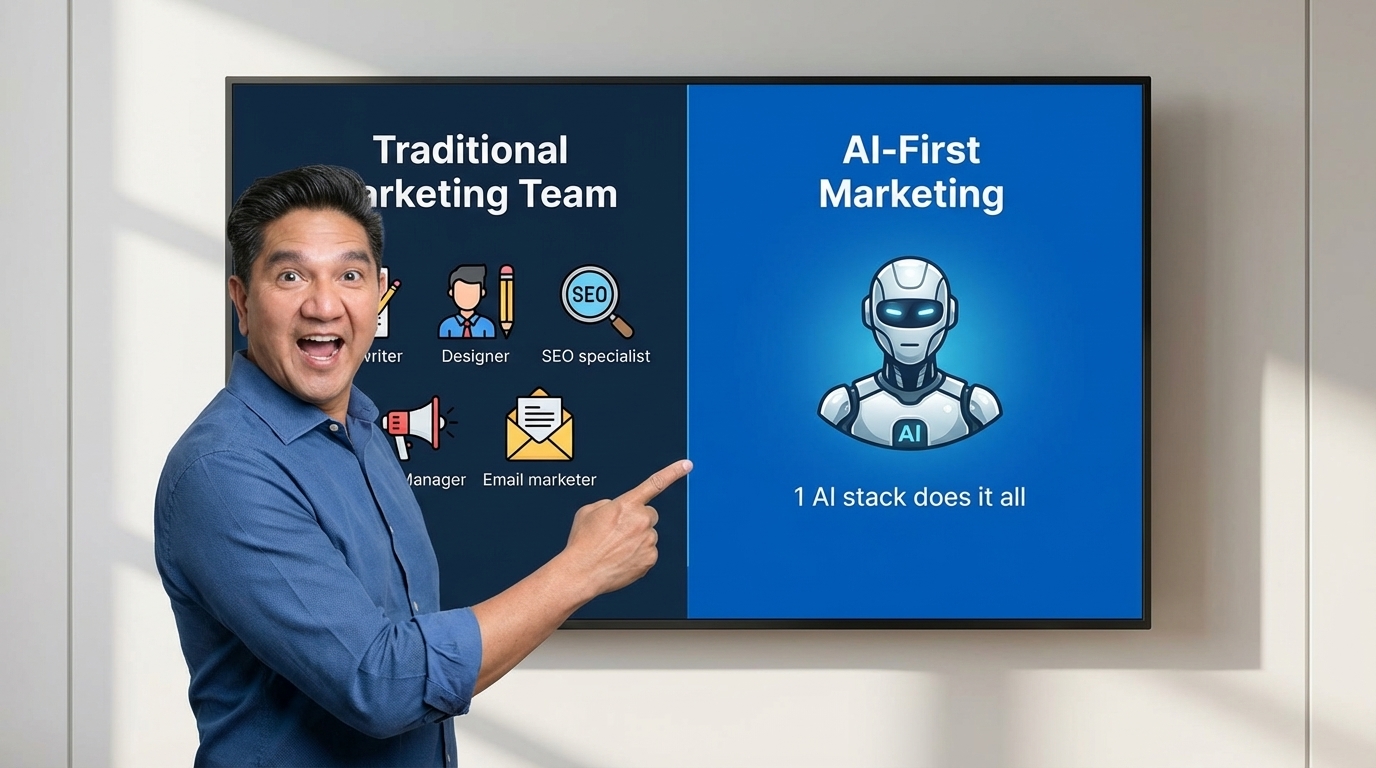
An AI first marketing department is not a traditional team with AI tools added on. It is a coordinated network of specialized AI agents, each responsible for one marketing function, with a single human strategist setting goals and approving outputs.
Quick Answer
An AI-first marketing department replaces siloed human roles with a coordinated agent network covering research, writing, SEO, social, email, and analytics. The human role shifts from production to strategy and final approval.
Most companies that claim an "AI marketing strategy" have actually deployed a collection of disconnected tools. That distinction matters more than people realize. A tool requires a human prompt every single time. An agent accepts a goal, builds a multi-step execution plan, runs it, and delivers a completed output. The operational difference is not small. It is a 10-50x difference in the volume of work one strategist can oversee.
According to IBM (2025), the agentic shift in marketing is defined by three capabilities traditional tools lack: memory across sessions, the ability to use external tools without human direction, and the ability to plan and execute multi-step tasks end to end. A chatbot responds to you. An agent works for you.
The six core functions an AI-first marketing department covers: content research and creation, SEO optimization, social media execution, email campaign management, paid advertising, and analytics with reporting. In a traditional team, each function requires a dedicated specialist. In an AI-first setup, each is an agent.
Key Takeaway
An AI-first marketing department runs on orchestration, not just automation. Any business can automate one task. The structural advantage comes from building a network where agents hand off work to each other without waiting for a human between steps.
What Marketing Tasks Can AI Agents Handle Autonomously Right Now?
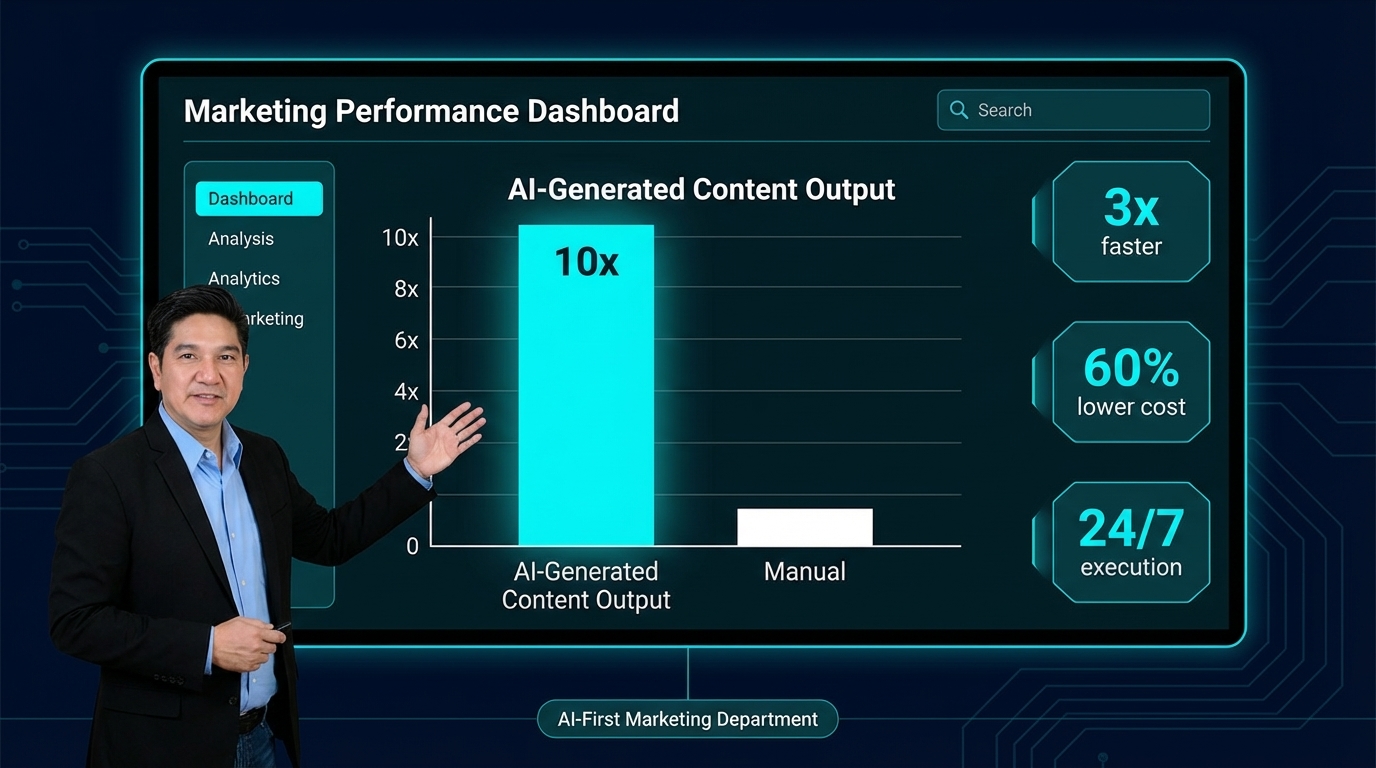
AI marketing agents can autonomously execute content research, article writing, SEO scoring, social media scheduling, email personalization and sequencing, lead scoring, A/B test creation, and campaign performance reporting. According to Improvado (2026), 91% of marketers now actively use AI in their workflows, and the tasks moving to full autonomy are those with repeatable inputs and measurable outputs.
Quick Answer
Today’s AI marketing agents handle content creation, SEO, social scheduling, email sequences, lead scoring, and analytics reporting without human prompts between steps. Tasks requiring brand judgment or client relationship calls still need human oversight.
The clearest signal of what is production-ready comes from verified deployments, not theoretical pilots. Adore Me moved from manually writing product descriptions over 20 hours per batch to reviewing AI-generated descriptions in 20 minutes per batch, according to Visme (2025). The stylists did not lose their jobs. They stopped writing and started approving. That is the pattern across every verified AI marketing case study: humans shift from doing to judging.
Platforms including Salesforce, HubSpot, Zapier, MindStudio, and Relevance AI ship native agent capabilities that handle workflow execution without custom engineering. A marketing director can deploy an agent that monitors campaign performance, identifies underperforming ad sets, pauses them, and generates a weekly summary, all without writing a line of code.
What remains human-dependent as of 2026: brand voice definition, creative direction approval, managing strategic client or partner relationships, and decisions with legal or regulatory implications. These are exactly the high-leverage activities that get crowded out when a team spends 80% of its time on execution.
This approach works best for any business with a recurring, volume-driven content or campaign need: e-commerce brands, service businesses with multiple locations, agencies managing multiple clients, or B2B companies running ongoing thought leadership programs.
Key Takeaway
The 80% of marketing work that is production and execution is ready for AI agents now. The 20% requiring judgment, relationships, and creative authority is where human marketers still own the outcome.
Why Does Multi-Agent Coordination Beat Isolated AI Tools by 90.2%?
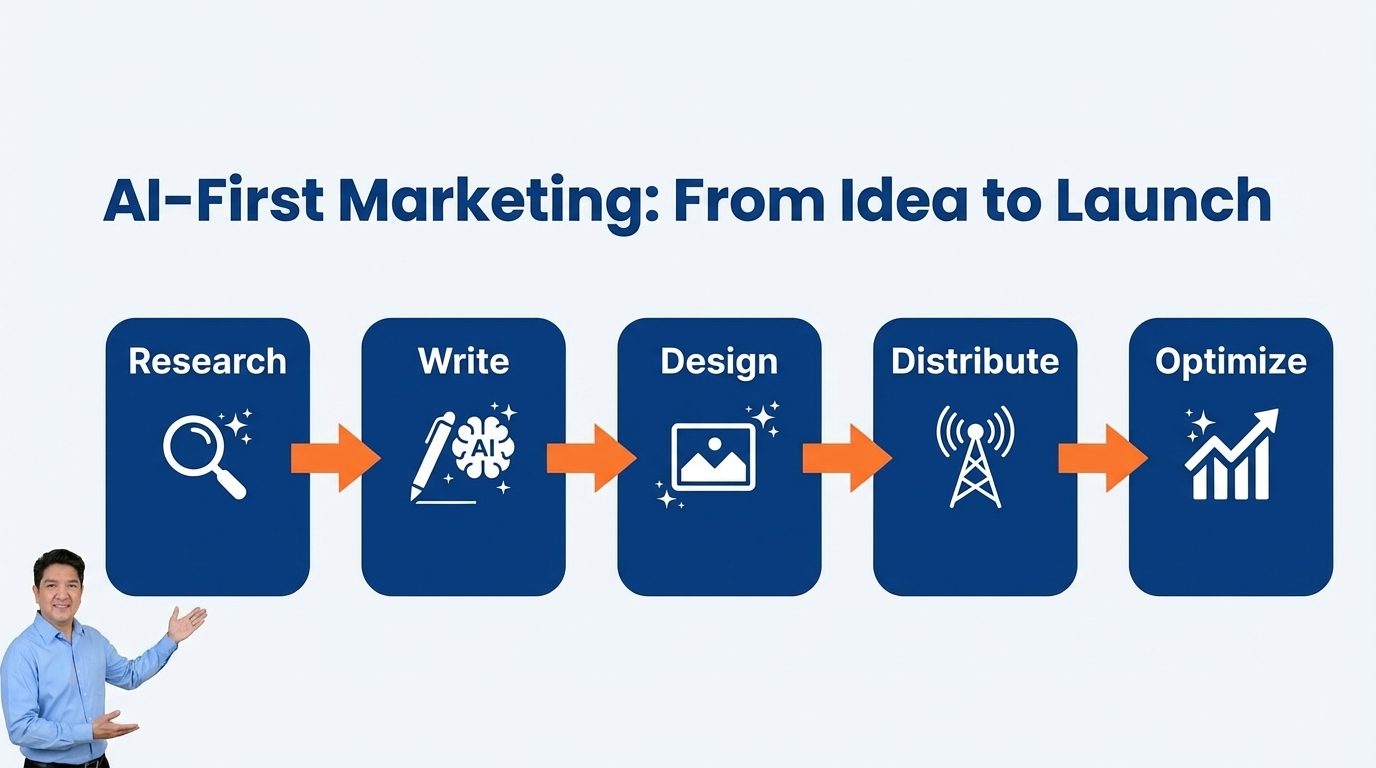
Multi-agent systems outperform single-agent approaches by 90.2% on complex tasks, according to Simplified (2026). That gap exists because complex marketing work requires sequential handoffs between specialists. A research agent must gather and validate sources before a writing agent drafts. That draft must exist before a scoring agent can evaluate SEO and AEO readiness. No single agent holds the full expertise for all three steps.
Quick Answer
Multi-agent systems beat single-agent by 90.2% on complex tasks because each agent specializes in one function and passes output to the next agent in the chain. No single agent can carry the context and skill required for end-to-end marketing execution.
Unlike standalone tools that each operate from a blank slate, a coordinated agent network compounds knowledge. The research agent's findings shape the writing agent's structure. The writing agent's output feeds the SEO scoring agent's evaluation. The scoring agent's feedback loops back to the writing agent for targeted revision. That is not automation. It is a production pipeline with memory.
The failure mode is documented and common: companies deploy 5-10 disconnected AI tools, each doing one thing in isolation. ChatGPT for copy. A separate tool for SEO. Another for social. Another for email. No shared memory, no coordination, no compound improvement over time. Every session starts from scratch. The 90.2% performance gap between multi-agent and single-agent is the measurable cost of that fragmentation.
GoAITeam LLC built an expert authority engine that operationalizes this architecture. A research agent analyzes sources and produces a structured Research Insight Map. A writing agent converts that map into a fully structured article. A schema agent generates JSON-LD markup. A scoring agent evaluates the article against 135 SEO checkpoints and 110 AEO checkpoints. A publishing agent deploys to WordPress with images, slug, and metadata intact. The human reviews and approves. The system produces content that competes with enterprise marketing teams running five full-time specialists, at a fraction of the cost.
Key Takeaway
The 90.2% performance advantage of multi-agent systems comes from specialization combined with coordination. Any business running disconnected AI tools is operating at a fraction of available capacity.
What Does the AI-First Marketing Org Chart Actually Look Like?
The AI-first marketing org chart has one human role at the center: the AI Workflow Architect (the evolved version of the Marketing Director). This person sets strategic goals, defines brand voice guidelines, approves final outputs, and monitors system performance. Every execution function runs through specialized agents.
Quick Answer
The AI-first org chart: one human AI Workflow Architect coordinating six specialized agents covering Research, Writing, SEO/Scoring, Social, Email, and Analytics. This structure replaces the traditional six-specialist team.
No top-ranking competitor for "AI agents marketing" has published this org chart. IBM, McKinsey, and MarTech all document what individual agents do but provide no guidance on how to redesign a team around them. That organizational design gap is where most AI marketing deployments stall: companies buy agent tools but never restructure the team around them.
The six-agent structure for an AI-first marketing department:
| Agent Role | Function | Human Equivalent |
|---|---|---|
| Research Agent | Topic analysis, source gathering, competitor gap mapping | Marketing Researcher ($70K/yr) |
| Content Agent | Article drafting, content calendar execution | Content Writer ($65K/yr) |
| SEO/Scoring Agent | Keyword targeting, on-page optimization, performance scoring | SEO Specialist ($70K/yr) |
| Social Agent | Post scheduling, engagement monitoring, platform adaptation | Social Media Manager ($60K/yr) |
| Email Agent | Sequence building, personalization, A/B testing, reporting | Email Specialist ($55K/yr) |
| Analytics Agent | Campaign performance reporting, trend identification, optimization signals | Analytics Specialist ($70K/yr) |
Traditional team total: $390,000/year in salaries before benefits and management overhead.
Marketing manager job postings are up 14% year-over-year in 2026 despite 91% AI adoption, according to Improvado (2026). The role is not disappearing. It is transforming. The AI Workflow Architect of 2026 spends less time in production and more time in systems design, brand strategy, and result evaluation. That is a better job by almost any measure.
Key Takeaway
The AI-first org chart is not a smaller marketing team. It is a different type of team: one human architect coordinating six specialized agents, each running at machine speed between task handoffs.
What Is the Real Cost Difference Between a Traditional Marketing Team and AI Agents?
A fully-staffed traditional marketing team covering six functions costs $390,000 or more per year in salaries before benefits, payroll taxes, and management overhead. An AI agent system delivering equivalent output costs $12,000-24,000 per year in platform and infrastructure costs. According to Simplified (2026), autonomous AI agents reduce marketing overhead by up to 80%.
Quick Answer
Traditional marketing team: $390K+/year in salaries. AI agent system delivering equivalent output: $12K-24K/year. The 80% cost gap is the CFO-level case for an AI-first marketing department.
This is not a technology story. It is a capital allocation story. The business that redeployed its $390K marketing payroll into AI infrastructure while competitors were still debating "whether to try AI" is now compounding a structural cost advantage that grows every quarter.
The full salary breakdown for a traditional six-specialist marketing team:
- Marketing Researcher: $70,000/year
- Content Writer: $65,000/year
- SEO Specialist: $70,000/year
- Social Media Manager: $60,000/year
- Email Marketing Specialist: $55,000/year
- Analytics Specialist: $70,000/year
- Total salaries: $390,000/year
Add employer payroll taxes at 7.65%, health benefits at $6,000-12,000 per employee per year, and management overhead, and a fully-loaded traditional marketing team costs well above $500,000 per year before software, tools, or agency fees.
SMBs spending $5,000-15,000 per month on marketing agencies are cutting those costs 60-80% by deploying AI agent systems that execute social, SEO, email, and paid ads with minimal human intervention, according to LeadsBuddha (2026). The agency model built on selling human hours is being disrupted from the bottom up by AI-first SMBs who recognized that the deliverable, not the hours behind it, is what the market pays for.
Without this cost frame, most marketing leaders treat the AI decision as a technology adoption question. The CFO frame changes everything: it is not a question of whether AI is ready. It is a question of whether your competitors have already redeployed the budget.
Key Takeaway
The $366K-378K saved annually on salaries can be redeployed into product, distribution, or market expansion while marketing output volume increases. That is the real business case for an AI-first marketing department.
Which Businesses Are Already Running AI Marketing Agents and What Did They Report?
Verified deployments in enterprise retail, beauty, and e-commerce between 2024 and 2026 produced consistent results: lower content costs, faster campaign turnaround, higher engagement rates, and measurable conversion improvements. These are not projections. They are reported outcomes from named companies with specific numbers.
Quick Answer
L’Oreal cut content costs 30% and increased engagement 35%. Adore Me cut product description time from 20 hours to 20 minutes per batch. A.S. Watson Group measured 396% better conversion with an AI-assisted customer advisor.
L'Oreal deployed AI agents across content creation and campaign management and reported a 30% reduction in content production costs, 50% faster campaign turnaround, and 35% higher engagement in emerging markets, according to Pragmatic Digital (2025). The 35% engagement increase in emerging markets is the number worth pausing on: the AI agent adapted content for local context faster than any centralized human team could execute at that scale.
Adore Me moved its product description workflow to AI-assisted generation and cut per-batch time from 20 hours to 20 minutes, with a 40% increase in non-branded SEO traffic, according to Visme (2025). Localized product launches that previously took months were reduced to 10 days. The stylists who had been writing descriptions shifted to reviewing and improving AI-generated outputs. Their expertise became more valuable as a quality filter than as a production function.
A.S. Watson Group deployed an AI customer advisory agent and measured a 396% better conversion rate among customers who interacted with it compared to those who did not, with those customers spending four times more per transaction, according to SuperAGI (2025).
The 52% of executives who have already deployed AI agents as of September 2025 (Google Cloud study) are not running pilots. They are scaling production systems. The 48% still evaluating are comparing theoretical risks of AI deployment against an increasingly concrete competitive disadvantage.
Key Takeaway
Every verified enterprise AI marketing deployment reported lower costs, faster execution, and measurable performance improvement. The risk of deploying is now smaller than the risk of waiting another quarter.
How Do You Launch an AI-First Marketing Department Without Starting Over?
The most common implementation mistake is attempting to replace the entire marketing function simultaneously. According to IBM (2025), the practical starting point is identifying one high-volume, repeatable marketing task and deploying a specialized agent for that function before expanding the network.
Quick Answer
Start with one high-volume task (content production or social scheduling), deploy a single specialized agent, measure the output at 30 days, then add a second function. Build the agent network one integration at a time.
A four-phase launch path for an AI-first marketing department:
Phase 1: Identify your highest-volume, most repeatable task. For most businesses this is content production (blog articles, product descriptions, email sequences) or social media scheduling. Pick the function where your team spends the most time and where output is measurable.
Phase 2: Deploy a single specialized agent with defined inputs and outputs. The agent needs three things to function effectively: a clear goal (publish two SEO articles per week targeting specific keywords), access to source materials (brand voice guide, past high-performing content, research data), and a quality feedback loop (a scoring system that measures each output against a defined standard before publish).
Phase 3: Connect to your existing tools. Salesforce, HubSpot, Zapier, MindStudio, and Relevance AI all provide agent workflow capabilities that connect to existing CRM and marketing stacks. You do not need to replace your stack. You need to add an agent layer on top of it.
Phase 4: Add agents by function as each integration stabilizes. After the content agent is running and the quality bar is consistent, add the SEO agent. After that stabilizes, add the social agent. The compound benefit accumulates as each agent's output feeds the next.
Marketing manager jobs are up 14% in 2026 (Improvado), which means the market is creating more demand for people who can direct AI systems, not fewer. The AI Workflow Architect role is not a threat to the marketing leader. It is the next version of the job.
Key Takeaway
An AI-first marketing department is built incrementally: one agent, one function, one integration at a time. Trying to replace everything simultaneously is how pilots fail without ever becoming production systems.
Frequently Asked Questions
What are AI marketing agents?
AI marketing agents are software systems that accept a marketing goal, build a multi-step plan to achieve it, and execute that plan autonomously without requiring a human prompt for each step. Unlike traditional AI tools that respond to individual queries, agents maintain memory across sessions, use external tools including search engines, publishing platforms, and CRM systems, and complete full workflows from research through delivery. According to IBM (2025), the defining capability of a marketing agent is autonomous multi-step task execution combined with the ability to adapt the plan when conditions change. A content agent that researches, writes, scores, and publishes an article is an agent. A chatbot that writes a paragraph when you ask it to is a tool.
What is the difference between AI tools and AI agents in marketing?
An AI tool responds to a single human prompt and produces one output. An AI agent accepts a goal, builds a plan to achieve it, and executes the plan across multiple steps without requiring human input between each step. According to Simplified (2026), multi-agent systems outperform single-agent tools by 90.2% on complex tasks because each specialized agent handles one function and passes its output to the next in the chain. ChatGPT used to draft a single blog post is a tool. A coordinated content agent that researches keywords, drafts a structured article, runs it through an SEO scoring system, and publishes it to WordPress is an agent workflow. The output volume difference between the two approaches is 10-50x for the same number of human oversight hours.
Can AI agents replace a marketing team?
AI agents replace the execution functions of a marketing team, not the strategic functions. According to Improvado (2026), marketing manager job postings are up 14% year-over-year in 2026 despite 91% AI adoption. The role is transforming, not disappearing. What AI agents eliminate is the 80% of marketing work that never required human judgment: scheduling posts, writing product descriptions, generating performance reports, running A/B tests, sending email sequences. The 20% that remains (brand voice definition, strategic positioning, creative direction, relationship management) is where human marketers create value that an agent cannot replicate. In every verified enterprise deployment, the result was not fewer marketers but more output per marketer, with the same headcount driving significantly higher marketing volume and better measured results.
How much does it cost to run AI agents for marketing?
An AI agent system delivering the equivalent output of a six-specialist marketing team costs $12,000-24,000 per year in platform and infrastructure costs. A fully-staffed traditional team costs $390,000 or more in annual salaries before benefits, payroll taxes, and management overhead. According to Simplified (2026), autonomous AI agents reduce marketing overhead by up to 80%. Platform costs vary by deployment: HubSpot AI features, Salesforce Einstein, Relevance AI, and MindStudio range from $1,000 to $5,000 per month for production-grade systems. For most businesses with existing marketing payroll, the ROI calculation turns positive within 30-90 days.
What is multi-agent marketing?
Multi-agent marketing is a system architecture where multiple specialized AI agents, each responsible for a distinct marketing function, coordinate their outputs in sequence to complete complex marketing tasks. A research agent gathers and validates sources, then passes a structured output to a writing agent. The writing agent produces a draft, which passes to a scoring agent. The scoring agent evaluates SEO and AEO performance, returns feedback to the writing agent for revision, and then passes the finalized article to a publishing agent. According to Simplified (2026), this coordinated architecture outperforms isolated single-agent approaches by 90.2% on complex tasks. Specialization combined with coordination produces compound improvement across every handoff.
How do AI agents improve SEO?
AI agents improve SEO by automating keyword research, content structuring, on-page optimization, internal linking, and performance monitoring at a speed and consistency no human team can match at scale. According to Visme (2025), Adore Me achieved a 40% increase in non-branded SEO traffic after deploying AI content agents. An AI SEO agent applies optimization rules consistently across every piece of content, flags underperforming pages for refresh, and identifies keyword gaps the team has not addressed. Human SEO specialists spend large portions of their time on manual audits and reporting. An AI SEO agent runs those processes continuously, surfaces only the decisions that require human judgment, and executes the rest automatically.
How do AI agents handle email marketing?
AI agents handle email marketing by autonomously building segmented sequences, personalizing content at the individual recipient level using behavioral data, running A/B tests, and generating performance reports without manual intervention between campaigns. Integration with CRM platforms including HubSpot and Salesforce lets the email agent pull contact data, trigger sequences based on behavioral signals such as page visits, form submissions, or product views, and adjust send frequency based on engagement metrics. The result is email personalization that previously required a dedicated specialist, running continuously, at the cost of platform fees rather than annual salary.
What companies are using AI agents for marketing right now?
Verified deployments as of 2025-2026 include L'Oreal (30% content cost reduction, 35% higher engagement in emerging markets), Adore Me (product description time cut from 20 hours to 20 minutes per batch, 40% SEO traffic increase), and A.S. Watson Group (396% better conversion with an AI customer advisory agent). According to Google Cloud (2025), 52% of executives say their organizations have deployed AI agents, the fastest enterprise software adoption curve on record. Platforms with active marketing agent deployments include Salesforce, HubSpot, Braze, Aprimo, MindStudio, and Relevance AI.
How do you measure ROI of AI marketing agents?
Measure AI marketing agent ROI across four dimensions: cost reduction (salary versus platform cost comparison), output volume (content pieces, campaigns, and social posts produced per month), performance improvement (organic traffic growth, conversion rate change, email engagement rate), and time-to-market reduction (campaign launch speed, content production cycle). Baseline each metric before deployment, then measure at 30, 60, and 90 days. According to LeadsBuddha (2026), SMBs transitioning from agency to AI-agent marketing report 60-80% cost reduction in the first 90 days. The most precise ROI calculation compares fully-loaded human cost (salary plus benefits plus tools plus management overhead) against fully-loaded AI system cost (platform fees plus human oversight time) for the same defined output volume.
What skills do marketers need in an AI-first team?
Marketers in an AI-first team need four skills that were previously secondary: prompt engineering (defining precise inputs and constraints for agents), workflow architecture (designing the handoff sequence between agents), output evaluation (identifying quality gaps in AI-generated content before publish), and systems monitoring (reading agent performance data and adjusting configuration when results drift). Traditional production skills including scheduling, description writing, and manual reporting become less critical as agents absorb those functions. Brand voice expertise becomes more critical, not less, because the AI Workflow Architect is the primary quality gate for everything the agent network produces. According to Improvado (2026), the marketing manager role is evolving into an AI workflow architect role.
How do AI marketing agents integrate with HubSpot or Salesforce?
AI marketing agents connect to HubSpot and Salesforce through native AI features and API integrations. HubSpot's AI assistant and agent tools connect to contact data, deal pipelines, and email workflows, letting an agent trigger personalized sequences based on CRM events without manual setup. Salesforce Einstein handles lead scoring, campaign optimization, and predictive analytics natively within the Salesforce ecosystem. Third-party platforms including Zapier, MindStudio, and Relevance AI provide agent workflow layers that connect to both CRM systems without custom engineering. In most deployments, the CRM is the source of behavioral data the agent uses to personalize outputs and trigger actions based on contact activity.
What is the first step to building an AI-first marketing department?
The first step is identifying the single highest-volume, most repeatable marketing task your team currently executes manually and deploying a specialized agent to handle it. According to IBM (2025), 50% of generative AI companies launched agentic pilots in 2025, and the ones that succeeded started with one high-volume use case rather than full-function replacement. For content-heavy businesses, the first agent is typically a content production agent. For e-commerce, it is often a product description or email sequence agent. For B2B, it is frequently a lead scoring or content distribution agent. Define the success metric before deployment, measure at 30 days, and expand to the second function only after the first is producing consistent results.
Sources
- IBM Think Topics — https://www.ibm.com/think/topics/ai-agents-in-marketing (2025)
- Google Cloud Press Corner — https://www.googlecloudpresscorner.com/2025-09-04… (2025)
- MarTech (Third Door Media) — https://martech.org/how-ai-agents-will-reshape-every-part-of-marketing-in-2026/ (2026)
- Improvado — https://improvado.io/blog/will-ai-replace-marketing-managers (2026)
- SuperAGI — https://superagi.com/ai-powered-marketing-automation-case-studies-on-how-ai-agents-boost-efficiency-and-roi-in-2025/ (2025)
- Visme — https://visme.co/blog/ai-marketing-case-studies/ (2025)
- Simplified — https://simplified.com/blog/automation/ai-agents-for-marketing (2026)
- LeadsBuddha — https://leadsbuddha.com/blog/ai-agents-replacing-marketing-workflows-2026 (2026)
- Pragmatic Digital — https://www.pragmatic.digital/blog/ai-marketing-case-study-successful-campaigns (2025)
Editorial Notice: This article is for informational purposes only and does not constitute marketing, financial, or business consulting advice. Information is current as of March 2026. Consult a qualified marketing or AI systems professional for advice specific to your business situation.