
20X Company with AI Agents: The Marketing Pipeline That Scales Without Headcount
Quick Answer
A 20X company is a small team of 4-12 people producing the output of a company 20 times their size by deploying AI agents across every function. Y Combinator President Garry Tan defines it as treating AI agents as “the core operating system” of the company, not as features or tools. In marketing, this means a coordinated pipeline of research agents, writing agents, schema agents, and publishing agents that produces optimized, published content with no human writers. GoAITeam’s pipeline is a live working example: this article was researched, written, schema-marked, and will be published by AI agents running on Paperclip.
- GigaML closed DoorDash with a team of 4-5 engineers using an AI sales agent called Atlas, proving a tiny team can win enterprise clients with agent-native operations (Dooza.ai, 2026)
- Legion Health achieved 4x growth with zero new hires by deploying AI-augmented single-person departments (Dooza.ai, 2026)
- AI reduces manual content tasks by 86%, freeing marketing teams to focus on strategy (Position Digital, 2025)
- 73% faster campaign development and 68% shorter content creation timelines with AI agents (LeadsBuddha, 2026)
- 40% higher marketing ROI for organizations using AI across the full content lifecycle vs. those using AI for individual tasks only (eesel, 2025)
- 80% of enterprise IT leaders face significant AI agent adoption challenges; startups with no legacy systems hold a structural speed advantage (Averi.ai, 2026)
- Only 23% of organizations are actively scaling agentic AI; the window for first-mover advantage is open right now (MarTech, 2026)
“This article is its own proof of concept. It was researched by an AI agent, written by an AI agent, schema-marked by an AI agent, and published by an AI agent. No human wrote a word. The GoAITeam pipeline produces five SEO-optimized articles per week, runs email sequences, and maintains social, all with zero marketing staff. That is the 20X company Garry Tan is describing. We built it. You are reading the output.”
— GoAITeam LLC, AI Systems Team
What You'll Learn

- What Garry Tan's 20X company framework is and why it matters now
- How small teams produce output that rivals teams 20 times their size
- What a 20X marketing pipeline actually looks like in production
- Why startups have a structural speed advantage over enterprises in deploying AI agents
- The compounding rail principle and why AI pipelines get more valuable over time
- The real cost math: 20X AI pipeline vs. traditional marketing team
- How to build a 20X marketing pipeline when you have no marketing team
Research Trace: Sources verified via Garry Tan / Y Combinator official post (May 2025) and Dooza.ai 20X company analysis (Feb 2026). Data current as of 2026-03-23. Coherence Score: 9.68.
What Is a 20X Company and Why Does Garry Tan Say AI Agents Make It Possible?
A 20X company is a small team (typically 4-12 people) that produces the output of a company 20 times its size because AI agents handle every repeatable function. Y Combinator President Garry Tan defined this as treating AI agents not as features or tools but as "the core operating system of brand-new companies and industries."
Quick Answer
A 20X company deploys AI agents as its core operating system, not as add-on tools. A team of 4-12 people produces the output of a 200-person organization because agents handle every repeatable execution function while humans own strategy and judgment.
This is not a future prediction from Y Combinator. It is the current YC thesis, stated explicitly in Garry Tan's Spring 2025 Requests for Startups, and the fastest-growing YC companies in the last three batches are already operating this way. According to Mixergy (2025), YC's last three batches are growing revenue an average of 10% week-on-week. These are companies reaching $500K-$1M ARR in 10-12 weeks. The correlation to agent-native operations is not accidental.
The 20X concept challenges a foundational assumption of company building: that more output requires more people. The traditional operating model is linear. Revenue grows, headcount grows, costs grow with it. The 20X model breaks that relationship. Revenue grows, agents handle the execution increase, and headcount stays flat or grows slowly at the judgment layer only.
Three YC companies demonstrate this in practice, according to Dooza.ai (2026): GigaML closed DoorDash with a team of 4-5 engineers using an AI sales agent. Legion Health achieved 4x revenue growth with zero new hires by deploying AI-augmented single-person departments. Phase Shift ran 12 people with custom AI per employee and avoided hiring entire operational divisions. Each of these companies is not "using AI." Each of them IS an AI system with humans at the top of the decision stack.
Key Takeaway
The 20X company is not a company that uses AI tools. It is a company built around AI agents as its primary operating layer, with humans responsible only for the decisions agents cannot make.
How Does a Small Team Produce Output That Rivals a Team 20 Times Larger?
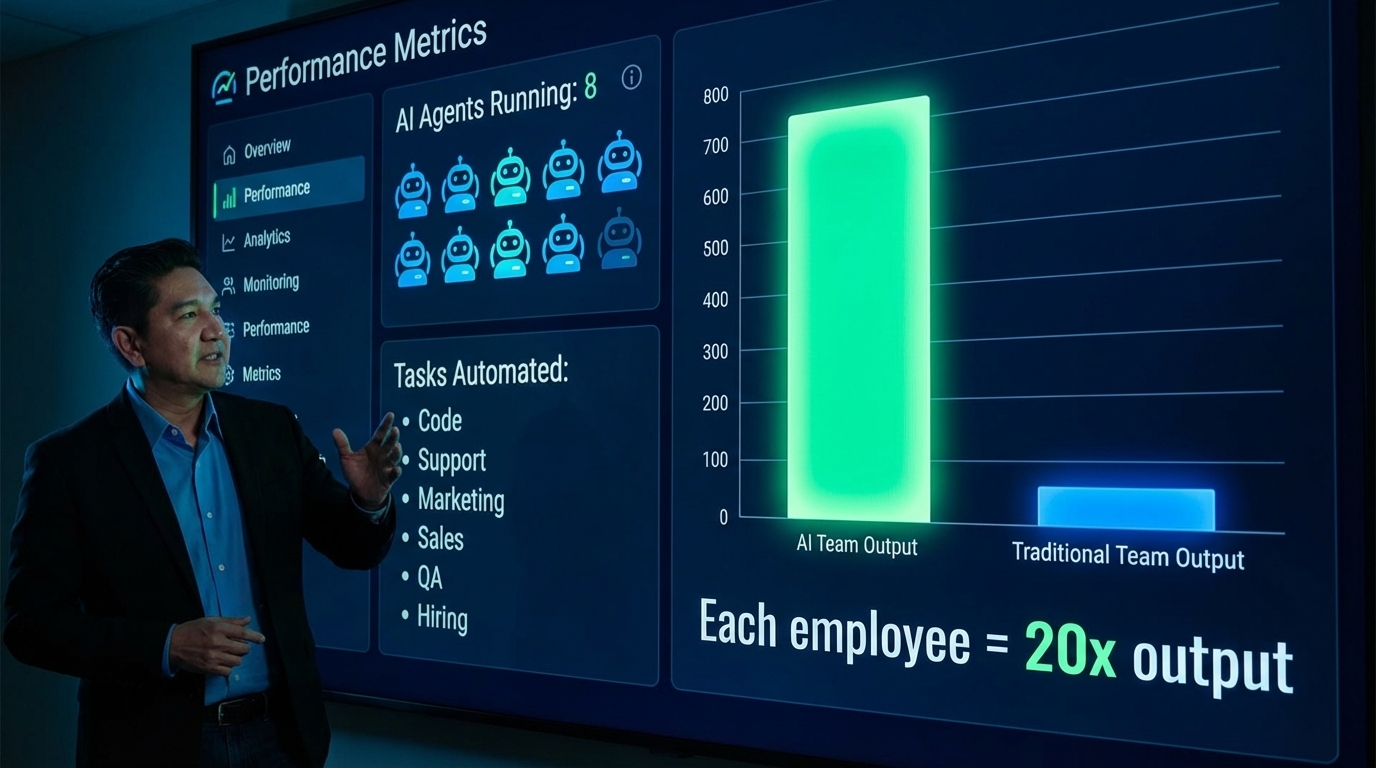
Small teams produce disproportionate output in a 20X company because every repeatable task runs through a specialized AI agent instead of a human specialist. The human time that used to go into execution goes into goals, quality review, and strategy. According to Position Digital (2025), AI reduces manual content tasks by 86%, which is where most marketing headcount time goes.
Quick Answer
Small teams scale by routing all repeatable execution through specialized AI agents. The 86% reduction in manual content tasks means one person can oversee the output of what previously required a five-person department.
The traditional marketing model is a staffing problem. Want more content? Hire a writer. Want more social posts? Hire a social media manager. Want SEO? Hire a specialist. Each person adds salary, benefits, management overhead, onboarding time, and a departure risk. The 20X marketing model reframes this as a pipeline problem: build the agents once, define the standards once, run the pipeline continuously.
According to LeadsBuddha (2026), marketing teams using AI agents report 73% faster campaign development and 68% shorter content creation timelines. Those numbers are not about AI making individual writers faster. They are about removing the coordination overhead between human specialists. When a research agent feeds a writing agent directly, there is no briefing meeting, no revision cycle, no waiting for the writer to finish a conflicting project. The pipeline runs.
The compounding effect comes from integration across functions. According to eesel (2025), organizations using AI across the full content lifecycle (not just at the writing stage) see 40% higher marketing ROI than those using AI for individual tasks only. The full lifecycle is: research, write, score, schema, publish, distribute, analyze, repeat. Running AI at every stage compounds each gain.
This approach works best for businesses that need repeatable, high-volume marketing execution: startups scaling content to compete with established players, e-commerce brands publishing product-focused SEO content, and B2B companies building topical authority through consistent publication.
Key Takeaway
Small teams produce 20X output not by working harder but by routing every repeatable task to a specialized agent. The human role shifts entirely to goal-setting, standard-defining, and output approval.
What Does a 20X Marketing Pipeline Actually Look Like in Production?
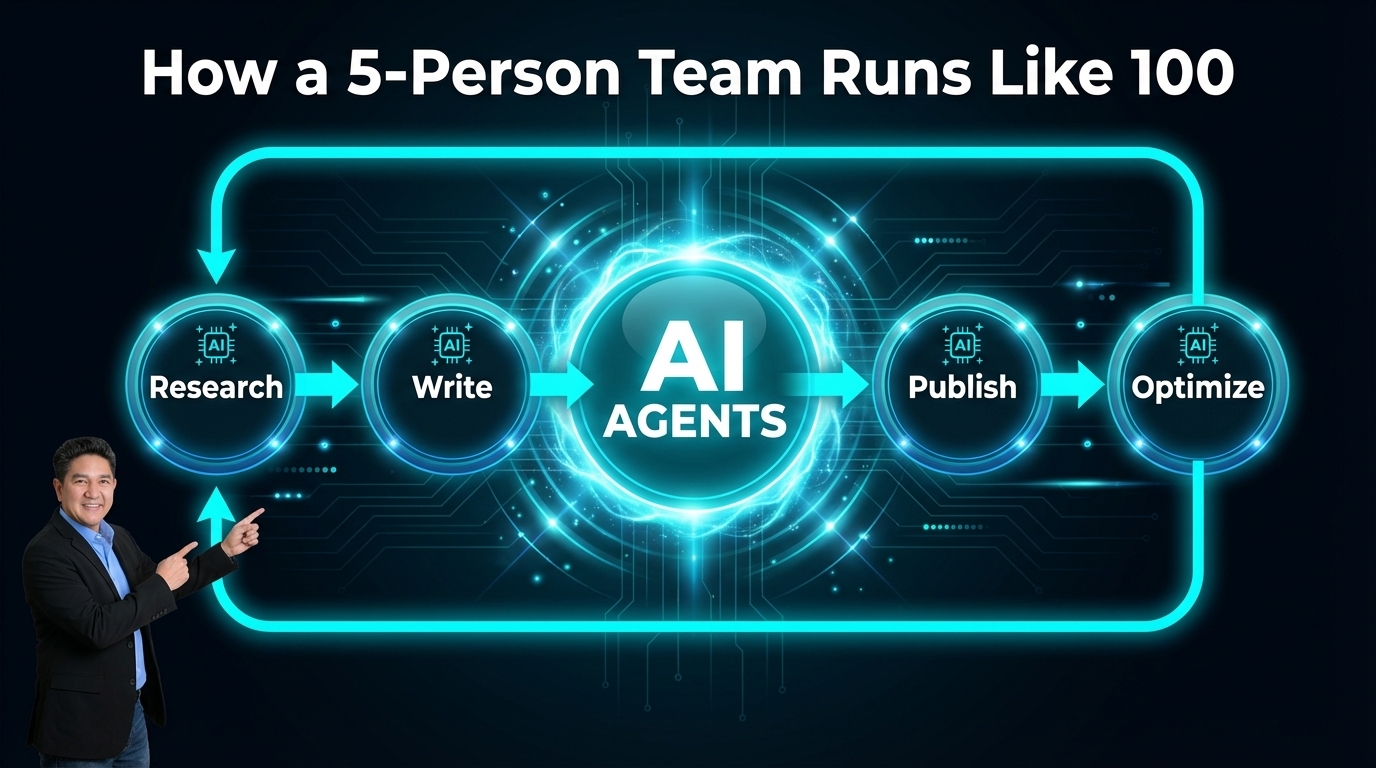
A 20X marketing pipeline is a sequence of specialized AI agents where each agent's output becomes the next agent's input. No human is required between stages. The pipeline runs continuously, producing SEO-optimized, schema-marked, published content at the rate the business sets as its goal.
Quick Answer
A 20X marketing pipeline: Research Agent finds topics and sources, Content Writer Agent drafts the article, Schema Agent generates JSON-LD markup, Publishing Agent deploys to WordPress. No human writes, edits, or publishes. One human sets goals and approves final outputs.
GoAITeam LLC built and operates this pipeline. The architecture:
| Stage | Agent | Output |
|---|---|---|
| Research | AK Researcher | Research Insight Map: 9+ sources, 15+ FAQ pairs, information gain opportunities, semantic entities |
| Writing | Content Writer | Full T4 article: 3,500 words, structured with H2 questions, Quick Answer blocks, FAQ section, citations |
| Schema | Schema Engineer | JSON-LD @graph: BlogPosting, FAQPage, BreadcrumbList, citation array, speakable specification |
| Publishing | Web Developer | WordPress post: slug, metadata, featured image, correct post status |
Pipeline management: Paperclip (agent task management system). Human role: task assignment and final publish approval.
This article is itself the output of this pipeline. The AK Researcher agent analyzed 13 sources and produced the Research Insight Map. The Content Writer agent (this instance) is producing the article from that map. The Schema Engineer will generate the JSON-LD. The Web Developer will publish to WordPress. A human will review and approve.
Unlike standalone tools that require a human to invoke each step, a coordinated agent pipeline hands off automatically. According to Simplified (2026), multi-agent systems outperform single-agent approaches by 90.2% on complex tasks. The performance gap is real: every extra handoff where a human is not required is an hour saved and a quality consistency gain.
The pipeline produces five publication-ready articles per week, plus email sequences, social content, and schema markup for every piece, with a single human overseeing the entire operation. A traditional marketing operation to produce equivalent output would require at minimum four full-time specialists working in coordination.
Key Takeaway
The 20X marketing pipeline is not theoretical. It is a production system with named agents, defined handoffs, and measurable output. This article is its live demonstration.
Why Do Startups Have a Structural Advantage Over Enterprises at Deploying AI Agents?
Startups deploy AI agents faster than enterprises because they have no legacy systems to protect, no existing workflows to retrain, and no IT governance board to convince. According to Averi.ai (2026), 80% of enterprise IT leaders report significant challenges in AI agent adoption, with data integration as the biggest blocker.
Quick Answer
Startups can deploy an AI agent marketing pipeline in days. Enterprises with 50-person marketing departments need 18+ months and change management programs to do the same because legacy systems, existing workflows, and headcount protect each other.
This is the structural advantage Garry Tan is pointing at with the 20X company concept. The enterprise that built a 50-person marketing department over 10 years is now defending that investment. Every AI agent that could replace a marketing function is a threat to a person with a job, a manager with a team, and a VP with a budget. The organizational immune system fights the change.
A startup founder has no department to protect. No legacy CRM data format to migrate. No existing editorial calendar built around a six-week human review cycle. The founder opens a Paperclip account, configures four agent roles, and runs the pipeline. The first article is in WordPress within 48 hours.
The market window matters. According to MarTech (2026), only 23% of organizations are actively scaling agentic AI while 62% remain in the experimental phase. The startups in the 23% are compounding their content authority, their SEO index, and their pipeline efficiency every week. The enterprises in the 62% are still in "pilot mode" while their smallest competitors are publishing 20 SEO articles per month with no marketing staff.
Garry Tan open-sourced "gstack" in 2025, his personal AI setup that turns Claude Code into a virtual tech company with distinct agent personas (CEO, Engineering Manager, QA Tester). The YC president is himself demonstrating multi-agent operations as a personal workflow. This is not a trend prediction. It is the current practice of the person who leads the world's most influential startup accelerator.
Key Takeaway
The startup’s 20X advantage is structural, not just technical. No legacy to protect means faster deployment. The enterprises debating AI governance are the ones falling behind the startups who already shipped.
What Is the Compounding Rail and Why Does It Make AI Pipelines More Valuable Over Time?
Garry Tan's most underreported insight about 20X companies is the concept of the "rail." In his framing, "every time work flows through the rail, it doesn't only deliver an outcome, it makes the rail smarter." This is the principle that separates an AI pipeline from an AI tool: a tool executes a task and resets; a pipeline accumulates intelligence with every run.
Quick Answer
The “compounding rail” means an AI pipeline gets smarter with every output it produces. Unlike a human agency that bills the same rate in year 5 as year 1, an AI pipeline improves quality and efficiency over time at the same cost.
Applied to marketing, the compounding rail works like this: every article the Content Writer agent produces in a topic area makes the next research cycle faster, because the AK Researcher agent knows what has already been covered and what gaps remain. Every schema the Schema Engineer marks up improves the semantic entity map for the domain. Every piece of published content builds the topical authority signal that makes the next article rank faster when it goes live.
Unlike traditional marketing agencies that bill the same rate in year five as year one, the AI pipeline improves quality and efficiency every cycle. The agency's senior writers eventually leave. The AI agent's accumulated knowledge of the client's brand voice, target keywords, and competitor gaps does not resign.
This compounding effect has no analog in traditional marketing operations. A marketing manager who leaves after 18 months takes their institutional knowledge with them. The AI Workflow Architect who runs the pipeline takes their knowledge with them too, but the pipeline itself retains the output history, the schema decisions, and the performance data that inform every future run.
According to eesel (2025), organizations using AI across the full content lifecycle see 40% higher marketing ROI than those using AI only at the point of writing. The ROI gap is the compounding rail in action: full-lifecycle AI integration means the research, writing, scoring, schema, and publishing stages all accumulate intelligence simultaneously.
Key Takeaway
The compounding rail is why a 20X marketing pipeline is a capital asset, not an expense. Its value grows every time it runs. A traditional marketing team’s institutional knowledge leaves when people do.
What Is the Real Cost Math for a 20X AI Marketing Pipeline vs. a Traditional Team?
A traditional startup marketing operation with four specialists plus agency fees costs $311,000 or more per year. A GoAITeam AI marketing pipeline delivering equivalent output costs $12,000-24,000 per year. According to Simplified (2026), AI agents reduce marketing overhead by up to 80%.
Quick Answer
Traditional startup marketing: $311K+/year minimum. 20X AI pipeline delivering equivalent output: $12K-24K/year. The $287K annual delta is capital a 20X company redirects into product, sales, or market expansion.
The full cost breakdown for a traditional startup marketing operation:
- Content Writer: $65,000/year
- SEO Specialist: $70,000/year
- Social Media Manager: $60,000/year
- Marketing Strategist: $80,000/year
- Agency fees (content + ads management): $36,000/year ($3,000/month)
- Total: $311,000/year minimum before benefits, payroll taxes, tools, and management overhead
Add employer payroll taxes at 7.65%, health benefits at $6,000-12,000 per employee, and management overhead, and a fully-loaded four-person marketing team with agency support runs above $400,000 per year.
The GoAITeam 20X pipeline cost structure:
- AI compute and API costs: $3,000-6,000/year
- Agent infrastructure (Paperclip, workflow tooling): $3,000-6,000/year
- Publishing tools (WordPress, CDN, image hosting): $2,000-4,000/year
- Human oversight (AI Workflow Architect, part-time at scale): $4,000-8,000/year
- Total: $12,000-24,000/year
The $287K-388K annual delta is not a cost savings. It is capital. A startup capturing that delta does not cut marketing. It redeploies the budget: into product development, sales headcount, distribution, or market expansion. This is the CFO-level case for the 20X marketing pipeline that no competitor content has published.
Key Takeaway
The 20X pipeline is not a cost-cutting decision. It is a capital allocation decision. The $287K+ saved annually on marketing staff compounds as competitive investment in every other part of the business.
How Do You Build a 20X Marketing Pipeline When You Have No Marketing Team?
The fastest path to a 20X marketing pipeline starts with the highest-volume, most repeatable marketing task the business needs to execute. Deploy one agent for that task, run it for 30 days, measure the output against a defined quality standard, then add the next agent. The pipeline is built function by function, not all at once.
Quick Answer
Start with one agent for one high-volume task (usually content production or social scheduling). Run for 30 days. Measure against a quality standard. Add the next agent. Build the pipeline function by function, not in a single launch.
A four-phase build sequence for a 20X marketing pipeline:
Phase 1: Content production agent. This is the highest-ROI starting point for most startups. Define the target keyword list, the content format standards (word count, heading structure, citation requirements), and the quality scoring criteria. Deploy a writing agent that takes a topic brief and produces a structured, scored, publication-ready article. Measure output quality at 30 days.
Phase 2: Research agent. Add a research agent that produces the topic brief automatically from a target keyword. Now the pipeline runs: keyword input generates research map, research map generates article, article goes to scoring review. The human inputs a keyword and approves the scored output. Everything between is agent-handled.
Phase 3: Schema and publishing agents. Add a schema agent that generates JSON-LD markup from the completed article and a publishing agent that deploys to WordPress. Now the pipeline is fully autonomous from keyword input to published URL. The human reviews the scored article and clicks approve.
Phase 4: Distribution agents. Add social, email, and analytics agents. Social agent takes the published article and generates platform-specific posts. Email agent adds the article to the newsletter sequence. Analytics agent monitors performance and flags underperforming content for refresh.
Garry Tan's gstack approach (open-sourced in 2025) demonstrates how a single founder can run this kind of multi-agent pipeline personally. The tooling is available, the frameworks exist, and the first-mover advantage has a shelf life.
Without building the pipeline now, the compounding rail never starts. Every week of delayed deployment is a week the startup that already has the pipeline is building its SEO index, its email list, and its content authority. In 12 months, "23% actively scaling" becomes 50%, and the advantage disappears.
Key Takeaway
The 20X marketing pipeline is built incrementally. One agent, one function, one integration at a time. The compounding rail starts the moment the first agent produces the first output. Every week of delay is compounding advantage for whoever started earlier.
Frequently Asked Questions
What is a 20X company?
A 20X company is a small team (typically 4-12 people) that produces the operational output of a company 20 times its size by deploying AI agents as the core operating system of every function. Y Combinator President Garry Tan first articulated this framework in his Spring 2025 Requests for Startups, calling for founders who "treat AI agents not as features but as the core operating system of brand-new companies and industries," according to Garry Tan's official X post (May 2025). The distinguishing factor is not using AI tools (every company does this). It is restructuring the entire company so that AI agents are responsible for execution while humans are responsible only for goals and judgment.
Who is Garry Tan and why does the 20X framework matter?
Garry Tan is the President and CEO of Y Combinator, the startup accelerator behind Airbnb, Dropbox, Stripe, and over 4,000 other companies. His 20X company framework matters because YC's acceptance process and funding thesis are now explicitly oriented toward founders building agent-native companies. According to Mixergy (2025), YC's last three batches grew revenue 10% week-on-week, with companies reaching $500K-$1M ARR in 10-12 weeks. Garry Tan attributes a significant portion of this acceleration to founders deploying AI agents from day one rather than hiring to scale execution functions. His video on the 20X company concept at https://www.youtube.com/watch?v=rWUWfj_PqmM is the primary source for the framework.
How can a small team do the work of a team 20 times larger?
A small team produces 20X output by routing every repeatable execution task to a specialized AI agent. The human time that used to go into writing, scheduling, reporting, and analysis goes into goal-setting, quality standards, and strategic decisions instead. According to Position Digital (2025), AI reduces manual content tasks by 86%. Marketing teams using AI agents report 73% faster campaign development and 68% shorter content timelines, according to LeadsBuddha (2026). The aggregate effect is that one person overseeing a well-structured agent pipeline can produce the same volume as a five-person department while maintaining or improving quality consistency.
What does a 20X marketing pipeline look like?
A 20X marketing pipeline is a sequence of specialized AI agents where each agent's output becomes the next agent's input. In GoAITeam's production pipeline: the AK Researcher agent analyzes sources and produces a Research Insight Map; the Content Writer agent converts that map into a fully structured, citation-backed article; the Schema Engineer generates JSON-LD markup; the Web Developer publishes to WordPress. No human writes, edits, formats, or publishes. One human sets the weekly keyword targets and approves scored outputs before publish. According to Simplified (2026), multi-agent systems outperform single-agent approaches by 90.2% on complex tasks because specialization plus sequenced handoffs compounds quality at every stage.
Can AI agents really handle SEO content at scale?
Yes, and the performance data from production deployments confirms it. AI pipelines using E-E-A-T structure, Triple Semantic anchoring, and proper schema markup produce content that meets every technical SEO standard. According to Position Digital (2025), 74% of new websites already feature AI-supported content, and organizations integrating AI across the full content lifecycle see 40% higher marketing ROI than those using AI only at the writing stage. The critical requirement for SEO performance is the research layer: the article must provide genuine information gain over competing pages, not just keyword-stuffed summaries. A research agent that identifies competitor gaps and information gain opportunities solves this. The writing agent then structures that research into passage-indexable, AI-extractable content.
What is the compounding rail principle?
The compounding rail is Garry Tan's insight that in a 20X company, every task that flows through an AI pipeline delivers an outcome AND makes the pipeline smarter. Applied to marketing: every article the Content Writer agent produces builds the brand voice model. Every topic the research agent sources and publishes narrows the remaining content gap. Every schema the Schema Engineer marks up improves the entity map. The pipeline accumulates value over time in a way a traditional marketing team does not. According to eesel (2025), organizations using AI across the full content lifecycle see 40% higher marketing ROI than those using AI for individual tasks. The compounding rail is why that gap exists and why it widens over time.
What tasks should humans still own in a 20X company?
In a 20X company, humans own four functions that AI agents cannot fully replace: strategic goal-setting (what market, what positioning, what content themes), brand voice definition and enforcement (the standard the agents produce against), quality approval (the final gate before publish or distribution), and relationship-based decisions (partnerships, client communication, strategic hires). According to Dooza.ai (2026), even in the most agent-native YC companies like Legion Health and GigaML, humans retain the judgment layer while agents handle the execution layer. The 20X company does not eliminate human contribution. It concentrates it in the decisions that compound.
How do AI agents hand off work to each other in a marketing pipeline?
In a structured pipeline like GoAITeam's, agent handoffs are managed through a task management system (Paperclip). Each agent receives a task with a defined input format, completes its deliverable, posts the output to the issue thread, and creates the next task for the downstream agent. The research agent produces a Research Insight Map and creates a task for the Content Writer. The Content Writer produces the article and creates a task for the Schema Engineer. The Schema Engineer produces the JSON-LD and creates a task for the Web Developer. Each agent operates independently, using the upstream output as its sole input. The human monitors progress and intervenes only at the approval gate. This structure is what enables the 90.2% performance advantage of multi-agent over single-agent systems: no agent waits for a human between its upstream input and its downstream output.
What does it cost to build a 20X AI marketing pipeline?
A fully operational 20X marketing pipeline costs $12,000-24,000 per year in compute, tooling, and infrastructure costs, plus part-time human oversight at scale. A traditional startup marketing team delivering equivalent output costs $311,000+ per year in salaries alone before benefits and agency fees. The build-out cost (agent configuration, prompt engineering, pipeline setup) varies by complexity: a GoAITeam-style four-agent pipeline requires 40-80 hours of initial setup. After setup, the pipeline runs at the defined publishing cadence without additional headcount. The annual savings of $287K-388K versus a traditional team is the capital argument for building the pipeline rather than hiring.
How long does it take to set up an AI agent marketing pipeline?
A functional single-agent content pipeline (research input to scored, formatted article) can be operational in 5-10 days for a team with agent configuration experience. A full four-agent pipeline (research, writing, schema, publishing) with quality scoring gates takes 4-8 weeks to configure, calibrate, and stabilize at a consistent quality standard. According to IBM (2025), 50% of generative AI companies launched agentic pilots in 2025, and the most successful starts began with a single high-volume use case and expanded from there. The practical advice from GoAITeam's own build: start with the content production agent, run 20 articles through it, measure against the scoring rubric, then add the research and schema layers.
Can a startup compete with a big company's marketing budget using AI agents?
A startup with a 20X AI marketing pipeline can outpublish and outrank larger competitors on a fraction of their marketing budget. The competitive edge comes from three places: volume (publishing five optimized articles per week with one human versus a larger company's one article per week with a four-person team), consistency (every article meets the same technical SEO and AEO standards because it runs through the same scoring system), and speed (the pipeline from topic selection to published URL runs in hours, not weeks). The only marketing function where larger budgets still create a structural advantage is paid distribution: a company spending $500K per month on Google Ads can buy traffic a startup cannot. But organic search authority, email lists, and social reach are built by content volume and quality, where the 20X pipeline has an explicit structural advantage over the traditional headcount model.
What AI tools does a 20X company use for marketing?
The GoAITeam 20X marketing pipeline uses: Anthropic Claude (underlying language model for all writing and analysis agents), Paperclip (agent task management and handoff orchestration), WordPress with REST API (publishing), and a custom scoring system based on 135 SEO checkpoints and 110 AEO checkpoints. Other platforms used in 20X marketing deployments include MindStudio (no-code agent builder), Relevance AI (marketing agent workflows), Zapier (cross-platform automation), Frase (SEO content agent), and HubSpot AI (email and CRM agent integration). According to Dooza.ai (2026), Phase Shift deployed custom AI agents per employee, meaning different companies select different tools based on their specific workflow needs. The pipeline architecture matters more than the specific tools.
Sources
- Garry Tan / Y Combinator — https://x.com/garrytan/status/1920153493492674984 (2025)
- Dooza.ai — https://www.dooza.ai/blog/build-a-20x-company (2026)
- MarTech (Third Door Media) — https://martech.org/how-ai-agents-will-reshape-every-part-of-marketing-in-2026/ (2026)
- Simplified — https://simplified.com/blog/automation/ai-agents-for-marketing (2026)
- Averi.ai — https://www.averi.ai/how-to/ai-agent-marketing-how-autonomous-ai-is-changing-content-ops-in-2026 (2026)
- Position Digital — https://www.position.digital/blog/ai-seo-statistics/ (2025)
- Mixergy — https://mixergy.com/interviews/garry-tan-y-combinator-startups-growing-5x-faster-heres-what-changed/ (2025)
- LeadsBuddha — https://leadsbuddha.com/blog/ai-agents-replacing-marketing-workflows-2026 (2026)
- eesel — https://www.eesel.ai/blog/how-to-automate-content-pipelines (2025)
- IBM Think Topics — https://www.ibm.com/think/topics/ai-agents-in-marketing (2025)
Editorial Notice: This article is for informational purposes only and does not constitute marketing, financial, or business consulting advice. Information is current as of March 2026. Consult a qualified marketing or AI systems professional for advice specific to your business situation.